
apollogroup.ee
Corporate website of the Apollo Group holding in Estonia — one recording, seven navigations, 312 requests, six nodes. A CookieYes consent-management platform operates on the site, with an equal-weight reject button and categories off by default, and it does its job: the Google Tag Manager container launches only CookieYes itself, and there is no analytics, advertising, social network or RTB in the recording at all. The only functional third-party resource besides consent is Monotype web fonts. The declared in the cookie document is broader than the actual, not the other way round. The browser did not send a DNT header.
Request timeline
Declared versus actual
Transfer timings
GTM-58XJ9NF; launches only CookieYes, no analytics or advertising tags fire.
CookieYes loads (script and banner) before any analytics or advertising fires.
Monotype web fonts. The visitor's IP address is visible to the Monotype server.
api/v1/ip — determining the IP address to record consent.
api/v1/consent — stores the user's choice.
Detected trackers
- CookieYes (cdn-cookieyes.com, log.cookieyes.com, directory.cookieyes.com) — consent-management platform; records consent and requests the visitor's IP address via directory.cookieyes.com/api/v1/ip
- Google Tag Manager (www.googletagmanager.com, container GTM-58XJ9NF) — tag container; in the recording it launches only CookieYes, and no analytics or advertising tags fire behind it
- Monotype Fonts (fast.fonts.net) — web fonts; on loading, the visitor's IP address is visible to the Monotype server
Context
apollogroup.ee is the corporate website of the Apollo Group OÜ holding (registration code 12383236, Tartu mnt 80D, Tallinn), which brings together the Apollo brands (cinemas, bookstores), Vapiano, KFC, LIDO, O’Learys, Blender, MySushi and others across the Baltics and Finland. The site is built on WordPress, Apache/ZoneOS server.
Processing is described by two Apollo Group documents: the cookie-use terms (common to all of the holding’s sites) and the privacy policy. Attached to the material are a PDF snapshot of the site and a screenshot of the cookie-settings window.
The measurement consists of one recording, seven navigations: the privacy-policy page, the cookie terms, and the sections about the group, investors and brands. Three hundred and twelve requests, six nodes. The recording was made on 20 September 2026.
Who data goes to directly
CookieYes (the consent platform), Monotype (web fonts). There is no analytics, advertising, social network or RTB in the recording.
Declared versus actual
The Apollo Group cookie document describes categories of cookies — necessary, statistical, preference, marketing — and states that third-party services are used on the basis of consent, which can be managed through the settings. Unlike the document for the Vapiano site of the same operator, here the specific tools (Google Analytics, Facebook) are not named by name — only the categories are given.
The measurement yields a discrepancy in the favourable direction: there is less actual than the document allows for.
The consent platform is present and operates on a prior-blocking basis. The Google Tag Manager container (GTM-58XJ9NF) loads at +549 ms, and the only thing it initiates next is the loading of the CookieYes consent-management platform (+647 ms), then its configuration, translations and banner images. In the screenshot, the cookie-settings window shows the ‘Functional’ and ‘Analytics’ categories with toggles off by default (the necessary ones are ‘always active’, locked) and three equal-weight buttons: ‘Reject all’, ‘Save my preferences’ and ‘Accept all’ — that is, refusal is available on equal footing with consent, and consent is an affirmative action rather than a pre-ticked box.
There is no analytics or advertising at all. Across 312 requests, not a single request to Google Analytics (no /g/collect), Facebook (no connect.facebook.net), advertising networks, social networks or RTB arises. A check of the entire file, including response bodies, yielded no match for these services; the only measurement identifier in the traffic is the GTM-58XJ9NF container itself, behind which no analytics or advertising tag fired. Consent in this recording was recorded at +5878 ms (log.cookieyes.com/api/v1/consent), and even after it no analytics or advertising requests appeared.
The actual third-party recipients are functional only. CookieYes (cdn-cookieyes.com, log.cookieyes.com) — the consent platform itself, which calls directory.cookieyes.com/api/v1/ip to determine the IP address for the purpose of recording consent. Monotype Fonts (fast.fonts.net) — web fonts, on the loading of which the visitor’s IP address is visible to the Monotype server. Neither of these resources is named by name as a recipient in the cookie document, but neither carries an analytics or advertising payload.
Consent: what is proven and what is not
Proven: a consent-management platform is present and precedes any tags. The loading of CookieYes (script and banner) is legible in the recording; it is initiated by the tag container and occurs before any analytics or advertising tag could fire.
Proven: there is no analytics or advertising in the recording. Across 312 requests there is not a single request to Google Analytics, Facebook, advertising networks or RTB — including the period after consent was recorded.
Proven: the categories in the banner are off by default, with an equal-weight refusal. In the screenshot the ‘Functional’ and ‘Analytics’ toggles are off, and the ‘Reject all’ button stands on equal footing with ‘Accept all’.
Not proven and not needed: the exact content of the consent record. The body of the api/v1/consent request is redacted in the “lean” file, so the specific decision recorded cannot be read from this file; this is immaterial to the conclusion, since there are no analytics or advertising tags in the recording at all.
Separately: the browser did not send a DNT header in this recording.
Bounds of observation
The measurement covers seven pages of the site. Observation captures the browser’s behaviour, not the internal side of the services: server-side processing and contractual relationships with recipients are not verified by a browser measurement. The legal assessment is made by the competent authority — in Estonia, Andmekaitse Inspektsioon.
The file is published redacted under a “lean” profile: cookie values in requests have been removed, the Cookie and Set-Cookie headers stripped; the redaction registry records 258 redactions and a checksum. The response bodies are largely preserved, but the bodies of the tag-container and consent-platform scripts are replaced with stubs, and the body of the consent record is redacted; the conclusion about the absence of analytics and advertising rests on the absence of the corresponding network requests. No security headers are observed on the domain’s own responses.
The identification of services relies on domains and address patterns: the consent platform — by cookieyes.com; the tag container — by googletagmanager.com and the identifier GTM-58XJ9NF; the fonts — by fast.fonts.net. The absence of analytics and advertising is established by the absence of requests to google-analytics.com, connect.facebook.net, doubleclick.net, googlesyndication.com and by the absence of measurement identifiers in the traffic.
Conclusion
The corporate website of the Apollo Group holding transmits no data to analytics or advertising when browsed. A CookieYes consent-management platform operates on the site with an equal-weight reject button and categories off by default, and it performs its task: the Google Tag Manager container launches only the consent platform itself, and there are no analytics, advertising, social or RTB requests in the recording at all — even after consent is recorded. The only actual third-party recipients are functional: CookieYes itself and Monotype web fonts; neither carries an analytics or advertising payload. The cookie document describes categories and allows for analytics and marketing subject to consent, so the declared is broader than the actual, not the other way round. As a soft caveat it can be noted that the Monotype web fonts load from a third-party server, so that server sees the visitor’s IP address, and that the domain itself sets no security headers; there are, in any case, no transmissions to analytics or advertising in the recording that these measures would protect.
How to verify: download the file and compute its checksum — sha256sum file.har (Linux, macOS) or certutil -hashfile file.har SHA256 (Windows); it must match the one shown. The conclusions apply to the scope of this measurement — see the limitations of the method.
ed9d24f38d521fca6a8f8c80762cb3ae6a80dd82c8fe448f931c8bcf4a29c060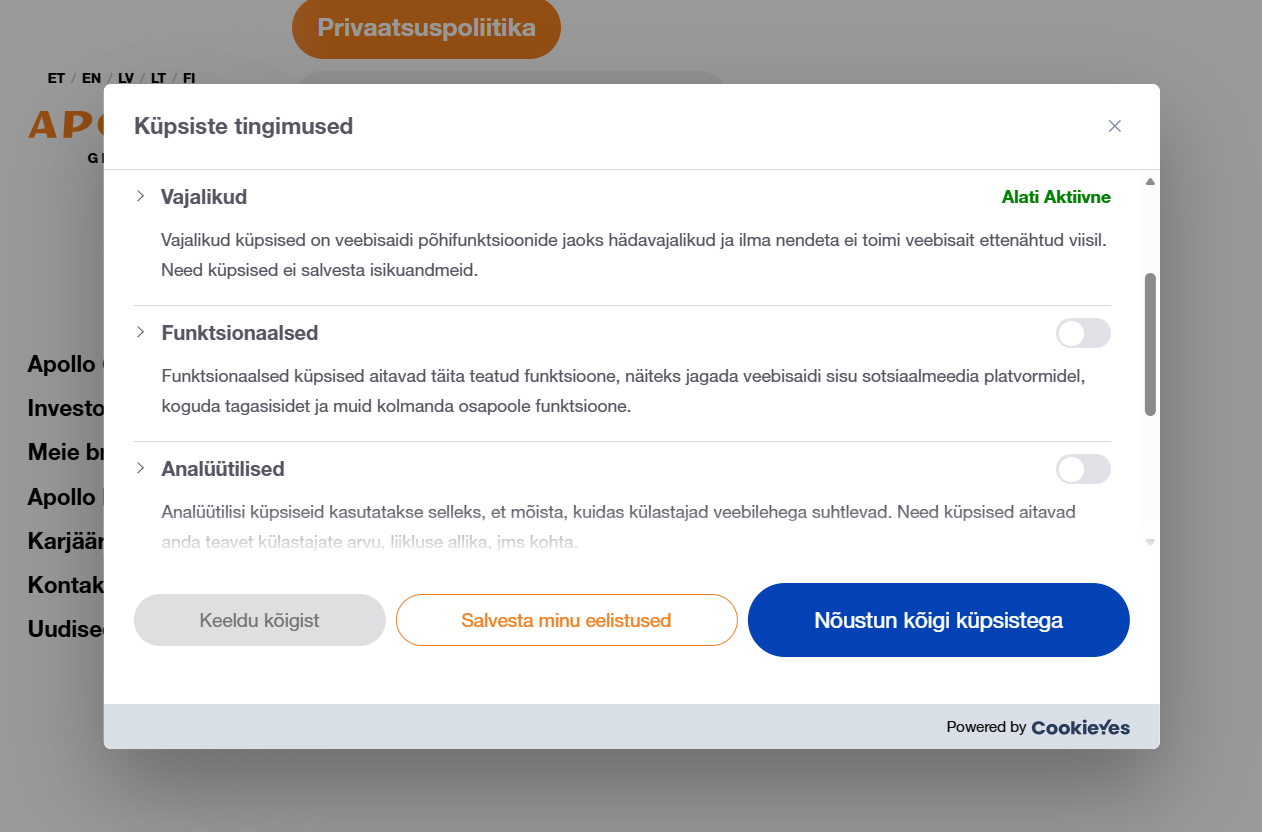
Want a response from the company about this audit? → Open the tool
Fill in once — it will be inserted into every letter below:
All fields are required to print the document — this is a formal requirement of the letter itself (the particulars of an official submission), not data collection: nothing is sent or saved anywhere, it all stays in your browser and disappears when you close the page. See the methodology for details.
RIA DigiDoc — phone · Smart-ID / Mobile-ID
Send this letter directly to the company first — before contacting the regulator it has the right to respond (GDPR Art. 12(3) — 30 days).
Тема: Запрос доступа к персональным данным (ст. 15 GDPR) — apollogroup.ee

Кому: [укажите адрес компании — DPO / поддержка / юридический отдел]
От: [Ваше имя], [контактный email]

Прошу предоставить доступ к моим персональным данным, обрабатываемым в связи с использованием сайта apollogroup.ee.

1. Категории данных и цели обработки (ст. 15(1)(a)-(c))
Прошу предоставить информацию по всем категориям, целям и получателям обработки моих данных на этом сайте — независимо от того, выявлены ли на сегодняшний день какие-либо несоответствия.

2. Получатели, сроки хранения и передача за пределы ЕЭЗ (ст. 15(1)(c)-(d), 46)
Прошу также указать полный список третьих лиц-получателей, применимые сроки хранения по каждой категории и правовые основания передачи данных за пределы ЕЭЗ, если таковая происходит. Полный технический разбор с доказательствами (сохранённый сетевой журнал, контрольная сумма SHA-256) опубликован по адресу: https://gdpru.eu/en/audits/ee-apollogroup-ee/

3. Автоматизированная обработка и профилирование (ст. 15(1)(h))
Прошу сообщить, применяется ли в отношении меня автоматизированное принятие решений или профилирование, и если да — раскрыть логику такой обработки.

С уважением,

[Ваше имя]
[контактный email]
[Страна]


[Дата]
Subject: Data access request (GDPR Art. 15) — apollogroup.ee

To: [insert the company's address — DPO / support / legal department]
From: [Your name], [contact email]

I request access to my personal data processed in connection with the website apollogroup.ee.

1. Categories of data and purposes of processing (Art. 15(1)(a)-(c))
I request information on all categories, purposes, and recipients of my data processed on this site — regardless of whether any non-compliance has been identified to date.

2. Recipients, retention periods, and transfers outside the EEA (Art. 15(1)(c)-(d), 46)
I also request the full list of third-party recipients, the applicable retention period for each category, and the legal basis for any transfer of data outside the EEA. The full technical audit with evidence (saved network log, SHA-256 checksum) is published at: https://gdpru.eu/en/audits/ee-apollogroup-ee/

3. Automated processing and profiling (Art. 15(1)(h))
Please state whether I am subject to automated decision-making or profiling, and if so, disclose the logic involved.

Sincerely,

[Your name]
[contact email]
[Country]


[Date]
Teema: Isikuandmetele juurdepääsu taotlus (IKÜM art 15) — apollogroup.ee

Kellele: [märkige ettevõtte aadress — DPO / tugi / juriidiline osakond]
Kellelt: [Teie nimi], [kontakt-e-post]

Palun anda mulle juurdepääs minu isikuandmetele, mida töödeldakse seoses veebisaidi apollogroup.ee kasutamisega.

1. Andmekategooriad ja töötlemise eesmärgid (IKÜM art 15(1)(a)-(c))
Palun esitada teave kõigi minu andmete töötlemise kategooriate, eesmärkide ja vastuvõtjate kohta sellel veebisaidil — sõltumata sellest, kas praeguseks on tuvastatud mingeid mittevastavusi.

2. Vastuvõtjad, säilitustähtajad ja edastamine väljapoole EMP-d (IKÜM art 15(1)(c)-(d), 46)
Palun samuti esitada täielik loetelu kolmandatest isikutest vastuvõtjatest, iga kategooria puhul kohaldatavad säilitustähtajad ning andmete EMP-välisele edastamisele kohaldatav õiguslik alus, kui selline edastamine toimub. Täielik tehniline analüüs koos tõenditega (salvestatud võrgulogi, SHA-256 kontrollsumma) on avaldatud aadressil: https://gdpru.eu/en/audits/ee-apollogroup-ee/

3. Automatiseeritud töötlemine ja profiilianalüüs (IKÜM art 15(1)(h))
Palun teatada, kas minu suhtes kohaldatakse automatiseeritud otsuste tegemist või profiilianalüüsi, ning kui jah, siis avaldada selle loogika.

Lugupidamisega,

[Teie nimi]
[kontakt-e-post]
[Riik]


[Kuupäev]